Skip to content
 Astercook Deep-Carbonized Bamboo Cutting Board Set with Stand Review: Is It Worth It?
A cutting board set sounds straightforward until you actually try to use three boards in a kitchen that was not designed for three boards. The Astercook Deep-Carbonized Bamboo Cutting Board Set with Stand (model A60.CBD1301B) tries to solve that problem by bundling multiple prep surfaces with a vertical stand that keeps them off the counter when not in use. Whether that solution is genuinely useful or just a way to sell you more boards than you need is what this review works through.
This is a RESEARCH-BASED REVIEW. We have not personally cooked on this set. Our analysis draws on verified product specifications, material science of carbonized bamboo, and practical kitchen-use reasoning. Where evidence is absent, we say so plainly.
Quick Answer
The Astercook A60.CBD1301B is a competent multi-board bamboo set with a storage stand that genuinely earns its counter space if you prep across multiple food categories and want boards stored vertically. The deep-carbonized finish gives it a distinctive dark appearance and may offer modest surface hardness benefits, but it does not eliminate bamboo’s core maintenance requirements. If you already own one good large board and hand-washing multiple boards sounds like friction, this set adds more than it solves.
Best for: Home cooks who prep meat, produce, and bread separately; anyone replacing a cluttered drawer of mismatched boards; buyers who want a visually cohesive set that stores neatly.
Avoid if: You want dishwasher-safe boards, you have limited counter space for even a compact stand, or you prefer the proven durability of end-grain hardwood for heavy daily chopping.
What Is the Astercook A60.CBD1301B Set?
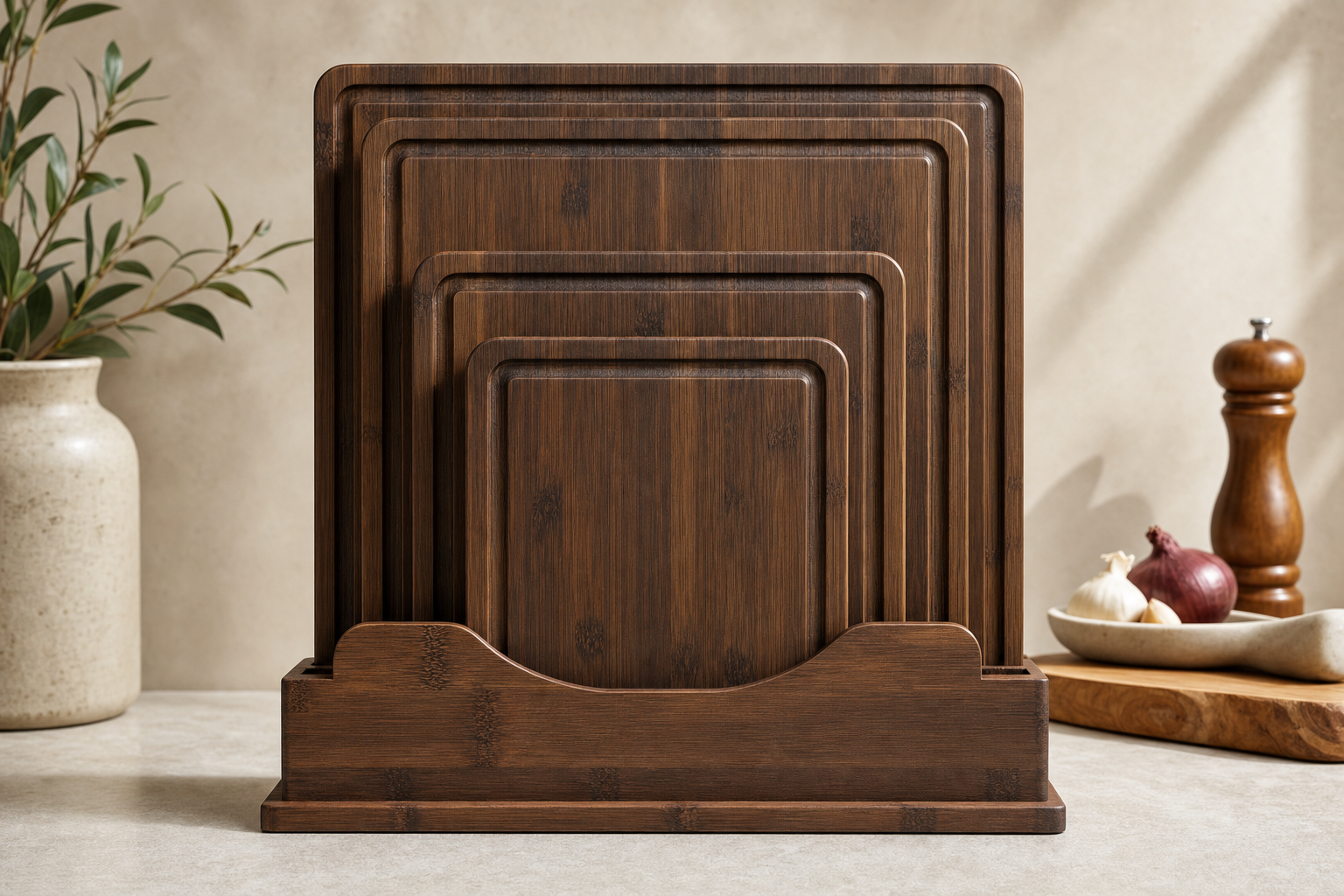
The set includes multiple bamboo cutting boards of different sizes and a stand designed to hold them vertically. The exact board dimensions and count are listed on the product page — read them there if you need precise measurements for a specific drawer or cabinet fit. Based on the product listing category and model description, the set is positioned as a complete prep-board solution: one large board for primary tasks, smaller boards for secondary prep, and the stand as the organizational anchor.
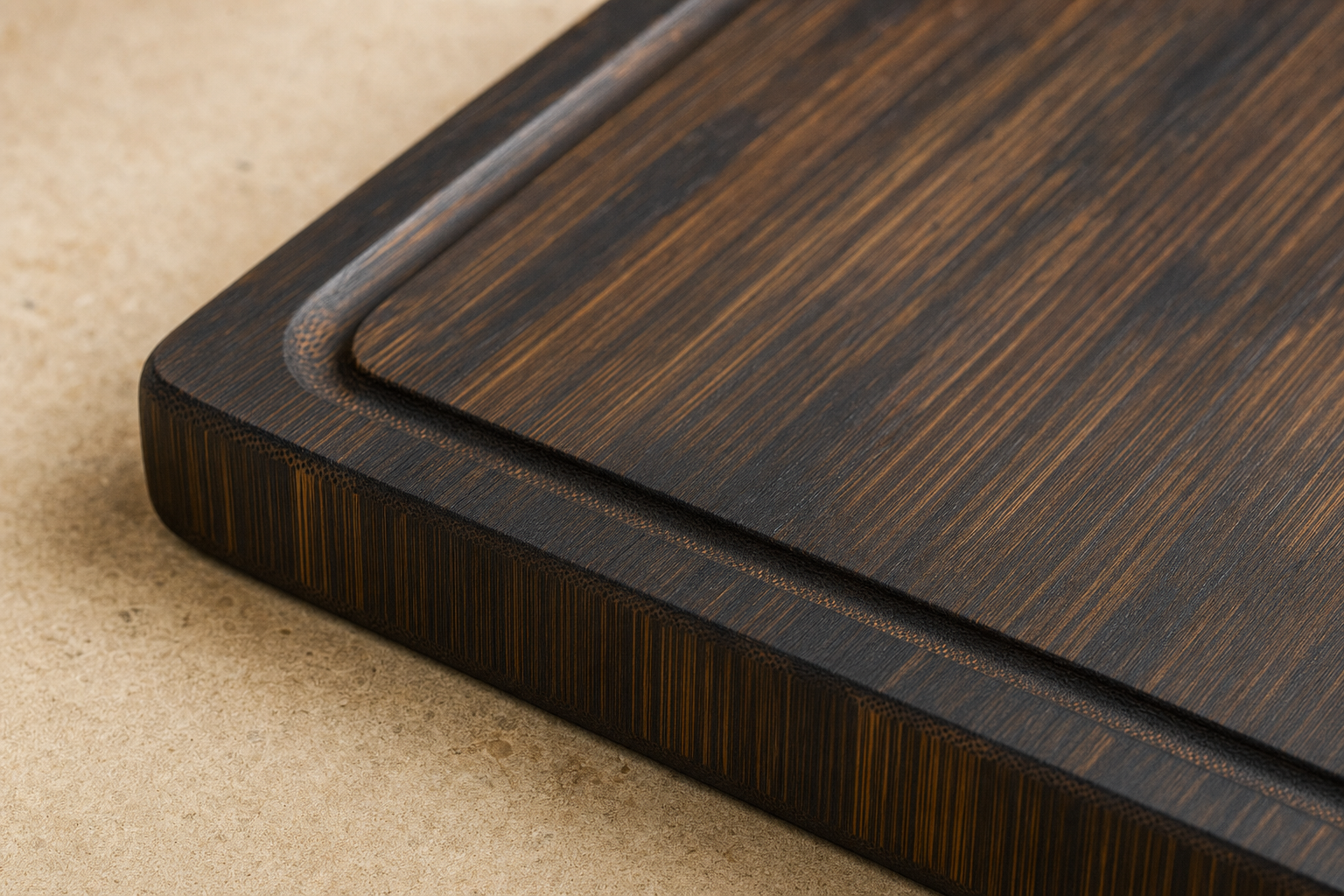
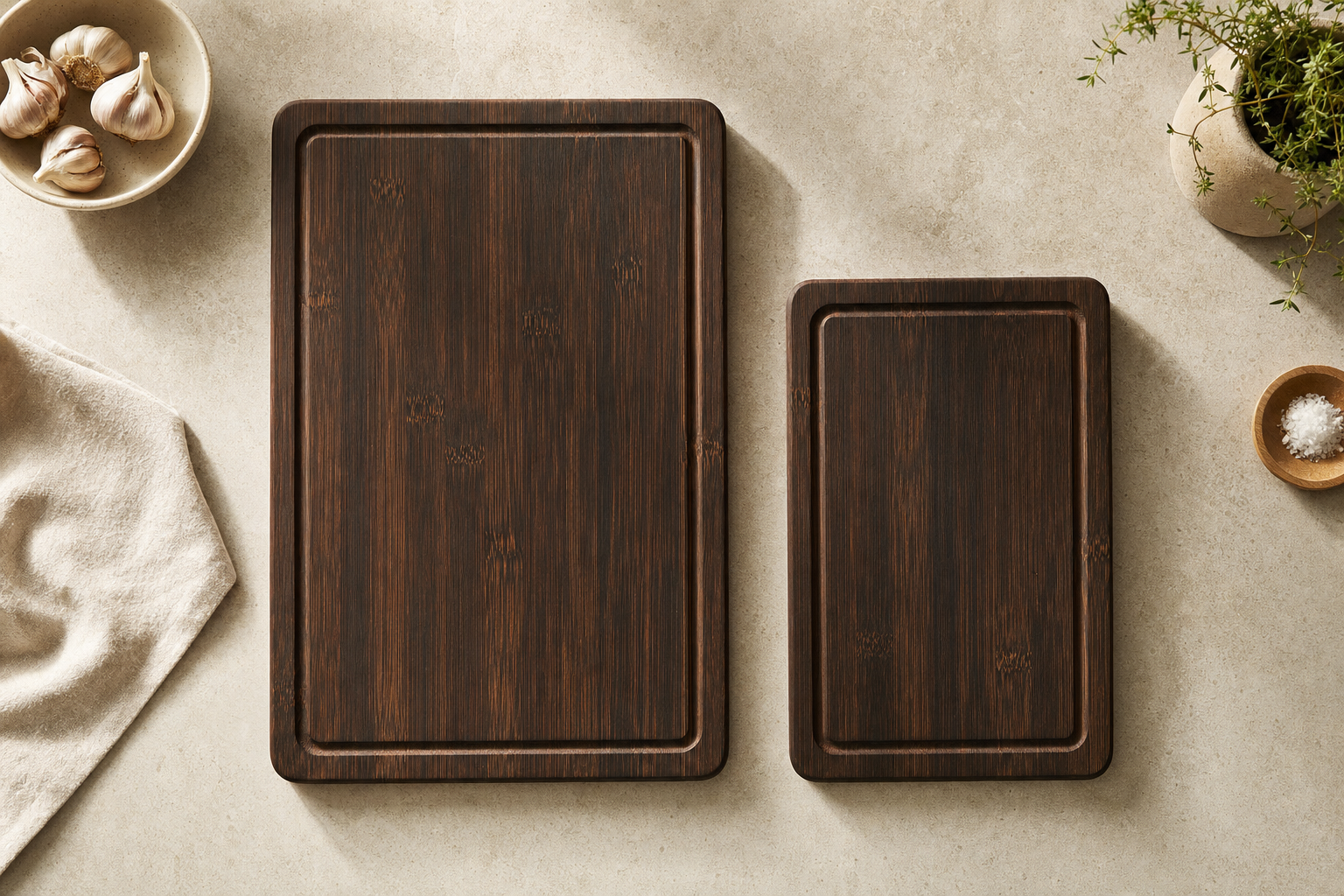
The defining material feature is the deep-carbonized finish. This is not a coating applied on top of the bamboo — it is a heat-treatment process that darkens the bamboo fibers throughout, producing the dark brown-to-near-black color that distinguishes this set from standard blonde bamboo boards.
Deep-Carbonized Bamboo: What It Actually Means for Your Kitchen
Carbonization in bamboo processing involves exposing the material to heat and steam, which caramelizes the natural sugars in the bamboo fibers. The result is the darker color. It also slightly softens the bamboo compared with uncarbonized bamboo, which is a tradeoff worth understanding before you buy.
Standard (blonde) bamboo is already harder than most hardwoods on the Janka scale, which is why it can be tough on knife edges over time. Deep-carbonized bamboo is marginally softer than its uncarbonized counterpart, which in practice means it may be slightly more forgiving on knives — but it also means the surface can show knife marks somewhat more readily. Neither effect is dramatic, but both are real.
The darker color does have a practical upside: staining from foods like beets, turmeric, or berries is far less visible on a dark surface than on blonde bamboo. That is a genuine quality-of-life benefit for cooks who prep colorful produce regularly.
What carbonization does not do: it does not make the board waterproof, dishwasher-safe, or immune to warping. Bamboo — carbonized or not — is a grass with a cellular structure that absorbs moisture. Prolonged water exposure, soaking, or dishwasher heat will cause warping and cracking in any bamboo board. That is not a flaw specific to Astercook; it is a material reality of the category.
Board Sizes and Real Use Cases
A multi-board set only earns its place in a kitchen if the size assortment maps to actual tasks. Based on the set’s positioning as a tiered prep solution, here is how the different boards likely function in practice:
- Large board: Primary workhorse for meat, whole vegetables, bread, and anything that needs room. This is the board you reach for most often. Its size matters most — a large board that is too small defeats the purpose of having a dedicated meat surface.
- Medium board: Secondary prep — slicing fruit, chopping herbs, or handling tasks that do not need the full large surface. Useful for keeping prep moving without washing the large board between tasks.
- Small board(s): Quick tasks: slicing a lemon, cutting a single onion, prepping garnishes. These earn their keep if you cook frequently enough that pulling out a large board for a 30-second task feels like unnecessary effort.
The honest question is whether you actually prep across enough categories simultaneously to need multiple boards in rotation. If your cooking style is sequential — one task, one board, wash, repeat — the size assortment matters less and the set’s value proposition weakens. If you prep multiple components at once, the assortment is genuinely useful.
The Vertical Stand: Space Saver or Counter Clutter?
Vertical board storage is a real organizational solution for one specific problem: boards that are too large to store flat in a drawer and too awkward to lean against a cabinet wall. The stand addresses that by giving the boards a fixed, upright home on the counter.
Whether that is a benefit depends entirely on your counter situation. If you have a dedicated prep zone with a few inches of counter depth to spare, a vertical stand keeps boards accessible without stacking or searching. If your counter is already crowded, the stand trades one storage problem for another — it just moves the clutter from a drawer to the counter surface.
The stand also only works as a storage solution if you actually return the boards to it after use. A stand that sits empty while boards migrate to the dish rack and then to a cabinet shelf is just a decorative object. That is a behavioral consideration, not a product flaw, but it is worth being honest about before buying.
One practical advantage of vertical storage that often goes unmentioned: boards stored upright dry more evenly after washing than boards laid flat or stacked. For bamboo, which needs to dry thoroughly to resist warping, this is a minor but real benefit.
Knife Friendliness and Surface Texture
Bamboo’s reputation as a knife-friendly surface is partially deserved and partially overstated. It is softer than ceramic or glass — both of which will damage knife edges quickly — but harder than plastic or most hardwoods. The deep-carbonized version of bamboo is marginally softer than standard bamboo, which edges it slightly toward the more knife-friendly end of the bamboo spectrum.
In practical terms: if you use quality knives and hone them regularly, bamboo is an acceptable surface. If you are using high-end Japanese knives with thin, hard edges, end-grain hardwood (maple, walnut) remains the more protective choice. Bamboo’s grain runs lengthwise rather than end-on, which means knife edges are cutting across fibers rather than between them — that is harder on edges over time than true end-grain boards.
The juice grooves included on these boards are a functional feature for meat prep, catching runoff that would otherwise reach the counter. Their depth and width are not stated, though their presence is confirmed by the product description.
Maintenance, Warping, and Long-Term Durability
This is where most bamboo cutting board reviews go vague. Here is what the evidence actually supports:
- Hand wash only. This is non-negotiable for any bamboo board. Dishwasher heat and prolonged water exposure will warp and crack bamboo. If dishwasher compatibility is a requirement, bamboo is the wrong material category entirely.
- Dry upright or flat immediately after washing. Do not leave bamboo boards soaking or lying wet on a dish rack for extended periods. The vertical stand is actually useful here — returning boards to the stand after washing promotes airflow drying.
- Oil periodically. Bamboo boards benefit from occasional treatment with food-safe mineral oil or board cream to prevent drying and cracking. How often depends on use frequency and your kitchen’s humidity. A rough guide is once a month for boards in regular use, but this varies. Neglecting oiling is the most common reason bamboo boards crack prematurely.
- Warping risk. Warping in bamboo boards is almost always caused by uneven moisture exposure — one side getting wet repeatedly while the other stays dry, or a board being stored flat while still damp. Proper drying and occasional oiling significantly reduce this risk, but do not eliminate it entirely.
Deep-carbonized bamboo does not have meaningfully different maintenance requirements from standard bamboo. The carbonization process affects color and surface hardness slightly; it does not change the material’s fundamental relationship with moisture.
Price and Value
We don’t print a price here — check the listing directly. Check price on Amazon before drawing conclusions about value.
What can be said about value in general terms: a multi-board set with a stand should be evaluated against the cost of buying equivalent boards individually plus a separate stand. If the set price is competitive with that sum, the bundling adds convenience without a meaningful price premium. If it is significantly more expensive than comparable individual boards, the stand needs to justify the gap on its own merits.
As a gifting option, a cohesive set with a stand has clear appeal — it looks considered and solves a real kitchen problem without requiring the recipient to source components separately. That is a legitimate use case for the set format beyond pure price efficiency.
Who Should Buy This Set and Who Should Skip It
Buy it if:
- You prep across multiple food categories (meat, produce, bread) and want dedicated surfaces for each
- You want boards stored vertically and accessibly, not buried in a drawer
- You are replacing a mismatched collection of boards and want visual and functional cohesion
- You are buying a kitchen gift and want something that looks intentional
- You are comfortable with hand-wash-only maintenance and periodic oiling
Skip it if:
- You need dishwasher-safe boards — bamboo is categorically not that
- You already own a large, well-maintained board and rarely prep multiple components simultaneously
- You use high-end thin-edged knives daily and want the most protective surface — end-grain hardwood is a better fit
- Your counter space is genuinely limited and a stand would create more friction than it solves
- You want a board that will last decades with minimal care — bamboo requires more active maintenance than plastic or hardwood to reach that lifespan
Frequently Asked Questions
Is the Astercook Deep-Carbonized Bamboo Cutting Board Set with Stand worth it?
For cooks who prep across multiple food categories and want organized vertical storage, yes. The set solves a real kitchen problem — board clutter and cross-contamination risk — in a visually cohesive package. For cooks who use one board for everything and rarely prep simultaneously, the set adds more boards than the workflow needs.
What comes in the Astercook A60.CBD1301B cutting board set?
The set includes multiple deep-carbonized bamboo cutting boards in different sizes and a vertical stand. Exact board count and dimensions should be read off the current listing, as specifications vary by production run.
Are Astercook bamboo cutting boards good for everyday cooking?
They are suitable for everyday cooking with appropriate care. Hand washing, prompt drying, and periodic oiling are required. Cooks who want a low-maintenance surface they can put in the dishwasher should look at plastic boards instead.
Does deep-carbonized bamboo resist warping and cracking?
Not significantly more than standard bamboo. Warping and cracking in bamboo boards are caused primarily by moisture mismanagement — soaking, dishwasher use, or uneven drying. The carbonization process affects color and surface hardness slightly but does not change the material’s fundamental moisture sensitivity. Proper care is the main defense against warping.
Is the included stand actually useful for storage?
Yes, if you have counter space for it and will actually use it consistently. Vertical storage keeps boards accessible, promotes airflow drying, and prevents the stacking and searching that makes multi-board sets frustrating. If your counter is already crowded, the stand may create more friction than it solves.
Are these bamboo boards gentle on knives?
More gentle than ceramic or glass, and marginally more gentle than standard blonde bamboo due to the slight softening effect of carbonization. Less gentle than end-grain hardwood boards, which are the most protective surface for high-quality knife edges. For most home cooks using standard knives, bamboo is an acceptable surface.
Do the different board sizes make meal prep easier?
They can, if your cooking style involves prepping multiple components at once. Having a large board for meat and a medium board for vegetables in simultaneous use reduces cross-contamination risk and washing interruptions. If you cook sequentially rather than simultaneously, the size assortment adds less value.
Can Astercook bamboo cutting boards go in the dishwasher?
No. Bamboo cutting boards — including deep-carbonized bamboo — are hand-wash only. Dishwasher heat and prolonged water exposure will cause warping and cracking. This is a material limitation of bamboo, not a brand-specific issue.
How do you clean and maintain deep-carbonized bamboo cutting boards?
Wash by hand with warm soapy water immediately after use. Rinse thoroughly and dry upright or flat right away — do not leave boards soaking or wet. Apply food-safe mineral oil or board cream periodically (roughly monthly for boards in regular use) to prevent drying and cracking. Store in the vertical stand to promote airflow between uses.
Who should buy this Astercook cutting board set and who should skip it?
Buy it if you prep across multiple food categories simultaneously, want organized vertical storage, and are comfortable with hand-wash maintenance. Skip it if you need dishwasher-safe boards, already own a large well-maintained board, use high-end thin-edged knives that benefit from end-grain hardwood, or have limited counter space for a stand.
Final Verdict
The Astercook Deep-Carbonized Bamboo Cutting Board Set with Stand is a well-considered product for a specific buyer: someone who preps across multiple food categories, wants boards stored vertically and accessibly, and is willing to maintain bamboo properly. The deep-carbonized finish is a genuine aesthetic differentiator and offers minor practical benefits around stain visibility and marginal knife friendliness, but it does not change the fundamental maintenance equation for bamboo.
The set does not suit buyers who want dishwasher convenience, those who use one board for everything, or those who want the most knife-protective surface available. For those buyers, plastic or end-grain hardwood are more honest fits.
For the right buyer, this set earns its place. Check price on Amazon and compare it against buying equivalent boards and a stand separately — that comparison will tell you whether the bundle makes financial sense at the moment you are reading this.