Skip to content
Tested by Frank Mason
PURCHASED WITH OUR OWN FUNDS
What we tested
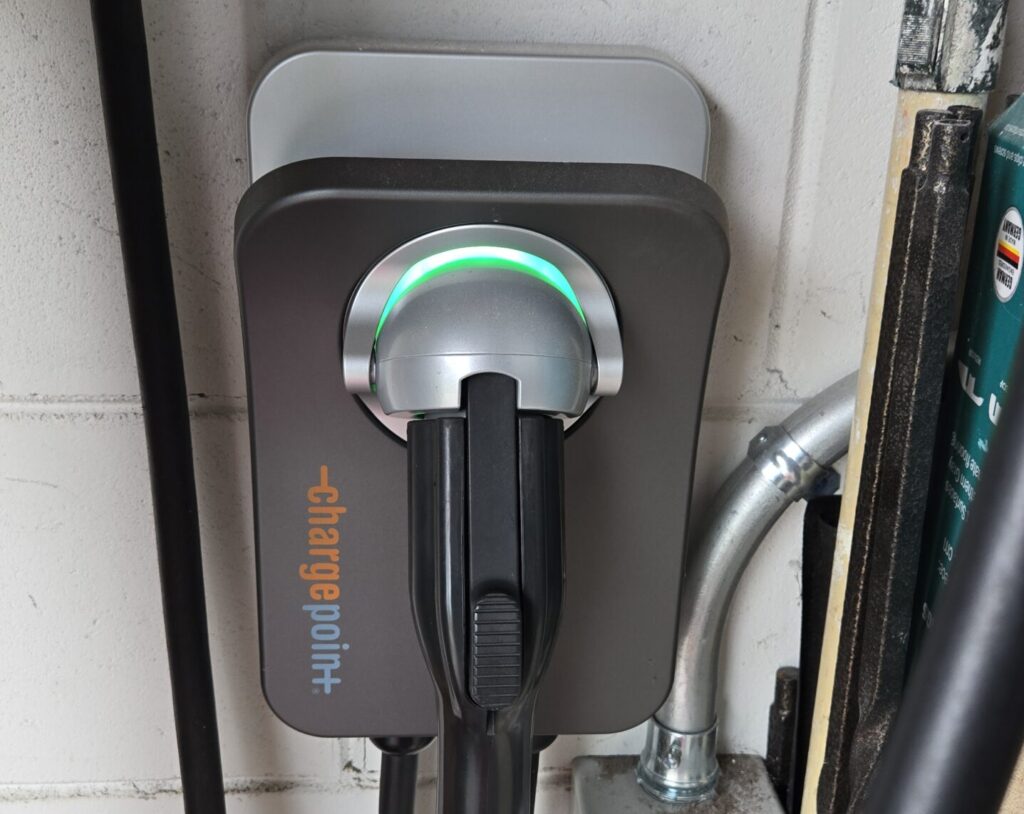
We bought the ChargePoint Home Flex with the NEMA 14-50 plug and have run it as our daily home charger since November 2025. It lives on a 50-amp circuit and does most of its work overnight. We paid for it ourselves. One limit worth stating up front: we owned and used the plug-in version, not the hardwired one this review recommends. Every hardwired figure below — the 16–50 amp range, the 20–80 amp breaker window, the 12 kW ceiling — comes from ChargePoint’s published specifications and installation documentation, not from our own testing.
The cheaper version is the faster one
On the same Amazon listing, the NEMA 14-50 plug-in version is $539 and the hardwired version is $494. The plug-in one is slower. ChargePoint’s own installation documentation limits plug-in installs to the 32-amp or 40-amp settings — 40 amps on a 50-amp breaker, and that is the ceiling. Only the hardwired install reaches the full 50 amps.
So the plug-in buyer pays $45 more for 9.6 kW instead of 12 kW. That is 20% less power for more money. If you are buying this charger, buy the hardwired one and have an electrician land it on the wall.
What’s good
The amperage range is the real feature. Per ChargePoint’s published specifications, a hardwired install accepts breakers from 20 to 80 amps and you set the output in the app — 16 amps on an old panel, 50 amps on a new one. We have not verified that range ourselves: our unit is the plug-in version, which ChargePoint limits to 32 or 40 amps. Nothing else in this price range adjusts that widely, and it is the difference between installing a charger and paying for a panel upgrade.
The app is the best in the category. Scheduling around off-peak rates works, cost tracking is accurate to the cent, and the same app handles public ChargePoint stations — one login for home and road.
The holster is a small thing that matters daily. It swivels, it is tapered so the connector drops in without aiming, and it is backlit. In a dark garage you notice.
The safety marks are real: UL listed, ENERGY STAR certified, NEMA 3R rated for outdoor mounting, 23-foot cable.
What’s not
The Wi-Fi module is the weak point. Across owner forums the same failure repeats: the unit charges fine, then stops connecting to the network somewhere after the first year and never reconnects. Owners describe long support calls and, in some cases, replacement units that failed the same way. ChargePoint’s warranty is three years, which covers the common failure window — but it covers the unit, not the second install.
The consequence is narrower than it sounds. A Home Flex that loses the network keeps charging at its set amperage; what you lose is scheduling, cost tracking, and remote control. If off-peak scheduling is the reason you are buying a smart charger, that is the reason to be cautious.
The company is the other risk. ChargePoint ran a 1-for-20 reverse stock split in July 2025 to hold its NYSE listing, and has posted declining revenue and shrinking cash reserves since. We are not predicting anything. We are saying that when the smart half of a smart charger depends on a company’s servers, that company’s balance sheet is a spec worth reading.
One more: the federal 30C tax credit that used to return 30% of charger and install costs, up to $1,000, expired June 30, 2026. Any guide still telling you to factor it in is out of date. The full price is now the price.
Who should buy it
Buy the hardwired Home Flex if you are running a new 50-amp circuit anyway, want to set the output yourself, and already use ChargePoint stations when you travel. That buyer gets the fastest speed on this page, the widest install flexibility, and one app for everything.
It is also the right pick for an older panel. Being able to dial output down to 16 amps on a hardwired install can keep you out of a $3,000-plus service upgrade.
Who shouldn’t
Don’t buy the $539 plug-in version. If you have a NEMA 14-50 outlet in the garage and want a smart charger for it, the Emporia Classic does 48 amps for around $399 with scheduling and energy monitoring. You give up the polished app and the better holster. You keep $140 and gain 8 amps.
Don’t buy it if your household mixes Tesla and non-Tesla vehicles. The Home Flex is J1772 in this configuration; the Tesla Universal Wall Connector handles both connectors in one unit for around $600 and solves a problem this charger doesn’t.
Specs
| Spec | Value |
|---|---|
| Model | ChargePoint Home Flex (CPH50) |
| Connector | SAE J1772 |
| Input | 240 V AC, single phase |
| Output — plug-in (NEMA 14-50) | 32 A or 40 A only · 9.6 kW max |
| Output — hardwired | 16–50 A adjustable · 12 kW max |
| Compatible breakers (hardwired) | 20 A – 80 A |
| Cable length | 23 ft |
| Enclosure rating | NEMA 3R (indoor/outdoor) |
| Certifications | UL listed · ENERGY STAR |
| Connectivity | Wi-Fi, ChargePoint app (iOS/Android), Alexa |
| Dimensions | 8 × 11 × 2.75 in |
| Weight | ~17.6 lb |
| Warranty | 3 years |
| ASIN | B07WXZDHGV |
We earn nothing on this review — there is no affiliate link on this page. Elsewhere on the site we may earn a commission when you buy through our links. Commissions never influence verdicts — here’s how we test.
The Shortlist Method
- Does the job5/5
- Built to last3/5
- Price honesty3/5
- Ownership friction4/5
- Beats the default4/5

How we tested this
Scored on our five standard criteria under The Shortlist Method — read the full methodology.