Skip to content
Quick Answer
Research summary
The ASUS Dual GeForce RTX 5060 8GB OC makes the most sense for buyers who already want an RTX 5060-class card and specifically care about a compact dual-fan design from a major board partner. The buying question is less about whether this exact model changes the GPU tier and more about whether ASUS’s cooler, card size, and mild factory overclock are worth any extra cost versus another RTX 5060.
The main tradeoff is straightforward: 8GB of VRAM is the part most likely to limit long-term comfort in newer, heavier games, especially if you expect to push settings hard or treat 1440p as the default target. If your plan is mostly 1080p gaming and you want a smaller card rather than a large triple-fan model, this version can be sensible. If the ASUS premium is large, the case for this specific card gets weaker.
The Product Shortlist may earn a commission from qualifying purchases. This does not affect our verdict.
This is a RESEARCH-BASED REVIEW, which matters here because buyers need to separate two decisions that often get blurred together: whether the RTX 5060 tier fits their needs, and whether the ASUS Dual GeForce RTX 5060 8GB OC is the right version of that GPU to buy.
That distinction is important. A board-partner model like this can improve practical ownership factors such as cooler layout, overall size, and likely noise behavior, but it does not remove the core limitation of the underlying 8GB memory configuration. For most shoppers, that is the real fork in the road.
What this card is really selling
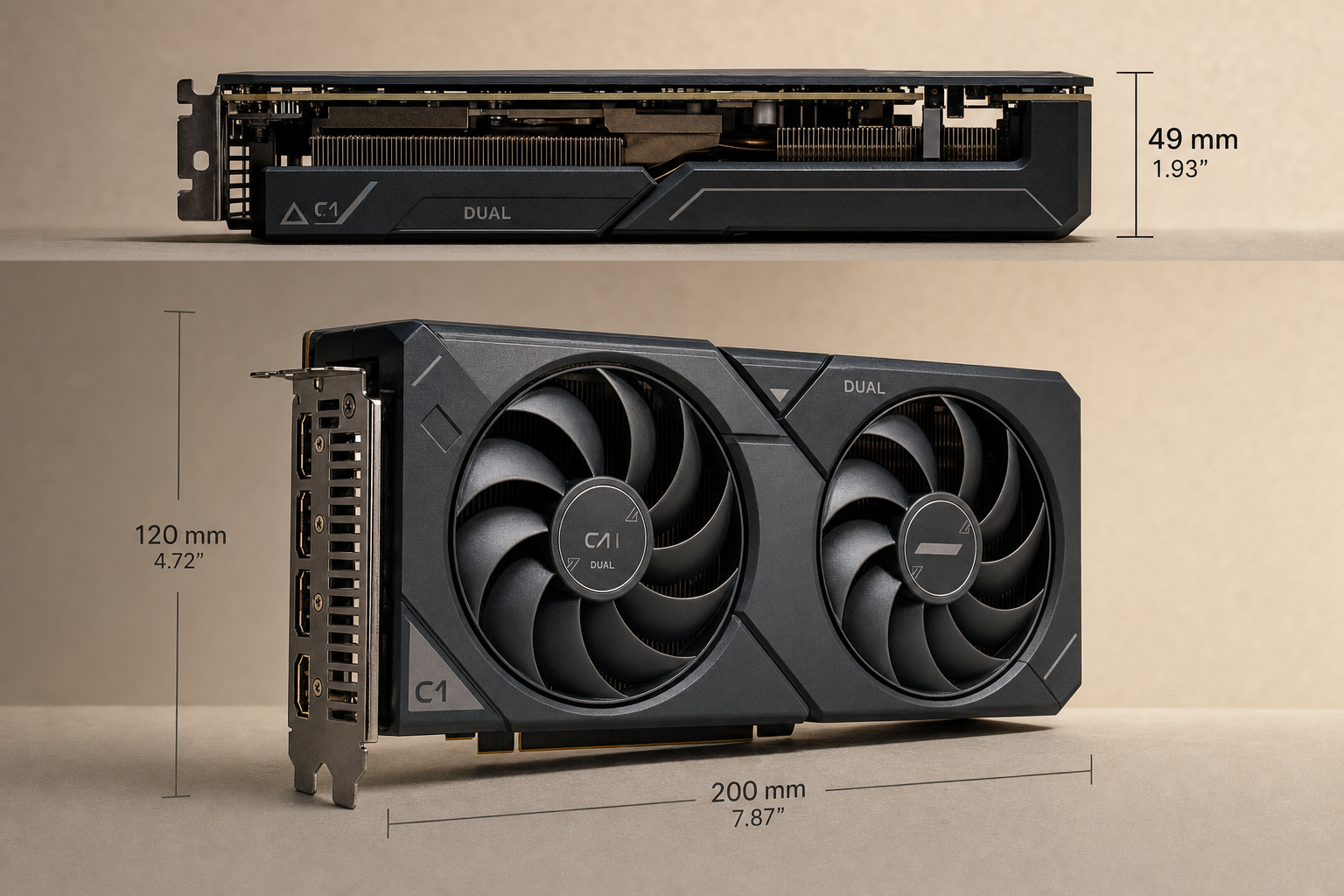
The ASUS Dual GeForce RTX 5060 8GB OC appears positioned around a familiar appeal: a more compact dual-fan card with a factory overclock, aimed at buyers who want a recognizable AIB brand without moving into oversized or likely pricier triple-fan territory.
That means the value case is practical rather than dramatic. You are not buying a different class of performance; you are deciding whether this specific implementation is a better fit for your case, your noise tolerance, and your trust in ASUS’s design choices than a cheaper RTX 5060 alternative.
The hard part is that the biggest discussion point around a card like this is not the shroud design or the OC label. It is 8GB of VRAM. For buyers focused on today’s 1080p gaming, that may still be acceptable depending on game choices and settings expectations. For buyers thinking about the next few years, heavier texture settings, or a more ambitious 1440p plan, it is the first reason to hesitate.
Who should consider it
- 1080p-first gamers who want an NVIDIA card in this tier and are not expecting miracles from an 8GB frame buffer.
- Compact-build buyers who prefer a shorter dual-fan style card over larger triple-fan designs, assuming final dimensions check out for their case.
- Shoppers already committed to the RTX 5060 tier and deciding between board-partner versions rather than between completely different GPUs.
- Buyers who value a simple, mainstream AIB option more than squeezing every last dollar of value from the category.
Who should skip it
- Buyers worried about VRAM longevity. If ‘RTX 5060 8GB VRAM enough’ is your central concern, this card does not solve it.
- 1440p-focused players who want more comfort headroom rather than compromises around settings and texture choices.
- Value shoppers facing a noticeable ASUS markup. A mild factory overclock usually does not justify paying much more for the same GPU class.
- Anyone who has not checked fit, outputs, or PSU needs yet. Those are product-specific details that should be verified before purchase rather than assumed from the GPU name.
What is specific to the ASUS Dual model vs the RTX 5060 itself
This is where many reviews get less useful. The chip-level story and the card-level story are not the same.
The RTX 5060 part of the story
At the GPU-tier level, buyers are mostly evaluating expected 1080p gaming use, the limits of 8GB VRAM, and whether NVIDIA-specific features matter enough to stay in this lane. Those broader points are not unique to ASUS.
The ASUS Dual part of the story
What could make this exact card worth choosing is the implementation: a compact dual-fan form factor, likely easier fit in more cases than bulkier cards, and a factory-overclocked SKU for buyers who prefer an out-of-box tuned variant. Those are meaningful buying factors, but only if they align with your build and the price difference is reasonable.
Just as important, those same traits create the main open questions. For an ‘ASUS Dual RTX 5060 review,’ the buyer needs verified answers on dimensions, slot thickness, connector placement, display outputs, PSU guidance, temperatures, and noise. Those details are card-specific and should be confirmed from ASUS documentation and reputable third-party testing before treating them as deciding facts. We do not have enough verified evidence here to state those specifics as settled.
Practical buying questions
Is it mainly a 1080p card or a real 1440p card?
Based on the product positioning and the 8GB memory configuration alone, the safer buyer framing is 1080p-first. That does not mean 1440p is impossible; it means 1440p should be approached as a compromise case rather than the clean default assumption.
Is 8GB of VRAM enough?
That depends on how tolerant you are of dialing back settings in newer or heavier games. If you tend to upgrade often, play lighter competitive titles, or simply want solid mainstream 1080p performance without chasing maximum textures, 8GB may still be workable. If you want more long-term breathing room, 8GB is the clearest reason to look harder at alternatives.
Are temperatures and noise likely the reason to pay extra?
They can be, but only with verified testing. In this category, board-partner cooling and acoustics are often the most practical reasons to choose one card over another. That said, it would be a mistake to assume the ASUS Dual cooler is definitively quieter or cooler than alternatives without source-backed testing for this exact model.
Does the factory overclock matter much?
Usually, the value of a factory overclock is convenience, not transformation. It may make this SKU a bit more appealing if the price gap is small. It is a weak reason to pay a substantial premium.
Bottom Line
If you are comparing this card as a specific product, not just as a generic GPU tier, the ASUS Dual GeForce RTX 5060 8GB OC looks most reasonable for a buyer who wants a compact dual-fan RTX 5060 for 1080p use and is not expecting 8GB of VRAM to age gracefully in every new release.
If your budget is tight, compare it very carefully against cheaper RTX 5060 variants. If your bigger concern is longer-term headroom, this is probably the point where you should widen the search rather than pay extra for a nicer version of the same 8GB constraint.
Worried about 8GB of VRAM? Our ASUS Dual GeForce RTX 5060 Ti 16GB OC review covers the 16GB option.
FAQ
Is the ASUS Dual GeForce RTX 5060 8GB OC good for 1080p gaming?
It appears best framed as a 1080p-first card. That is the clearest fit for an 8GB model in this class, especially for buyers who do not expect maximum-settings comfort in every newer game.
Is 8GB of VRAM enough for new games on an RTX 5060?
It can be enough for many buyers, but it is also the biggest long-term risk. If you want more texture headroom and fewer future compromises, 8GB is the main reason to be cautious.
How loud is the ASUS Dual RTX 5060 8GB OC under load?
That needs exact third-party testing for this specific card. A dual-fan design can be perfectly reasonable, but noise should not be assumed from the product name alone.
Does the ASUS Dual RTX 5060 8GB OC fit in small or compact PC cases?
It is likely aimed at buyers who want a more compact card than some larger alternatives, but actual fit depends on the verified dimensions, slot thickness, and connector clearance. Check those before buying.
What PSU do you need for the ASUS Dual GeForce RTX 5060 8GB OC?
You should confirm the official PSU guidance from ASUS and the GPU maker documentation before purchase. That is a specification-level detail we are not treating as verified here.
Is the factory overclock on the ASUS Dual model worth paying extra for?
Only if the premium is modest. A factory OC is usually a convenience feature, not a major step up in real-world class positioning.
How does the ASUS Dual RTX 5060 8GB OC compare with other RTX 5060 cards?
The biggest differences are likely to be cooler design, physical size, acoustics, and price rather than a dramatic performance gap. That is why paying too much extra for this version is hard to justify.
Is this card good for 1440p gaming or mainly 1080p?
The safer expectation is mainly 1080p. Treat 1440p as a more compromise-heavy use case, especially because of the 8GB VRAM limit.
Does the ASUS Dual RTX 5060 8GB OC support ray tracing, DLSS, and modern display outputs?
Feature support and exact output selection should be confirmed through NVIDIA and ASUS official documentation for this model. We are not stating those specifics here without direct verification.
Who should buy this card and who should skip it?
Buy it if you want a compact dual-fan RTX 5060 mainly for 1080p gaming and the price is sensible. Skip it if you are already worried that 8GB VRAM may feel limiting or if a premium ASUS price pushes you close to a stronger alternative.